July 29, 1977 - Braves knuckle ball pitcher Phil Niekro struck out four Pittsburgh Pirates in one inning - the first pitcher in Brave history to do so. It's possible because baseball rules provide that if a catcher fails to catch the ball on a batter's third strike, that batter can try to make first base. In such a case, if the batter makes first base, the pitcher is credited with a strike out, but the out doesn't count against the team at bat.
Friday, August 27, 2010
Knucksie K's four in one Inning
July 29, 1977 - Braves knuckle ball pitcher Phil Niekro struck out four Pittsburgh Pirates in one inning - the first pitcher in Brave history to do so. It's possible because baseball rules provide that if a catcher fails to catch the ball on a batter's third strike, that batter can try to make first base. In such a case, if the batter makes first base, the pitcher is credited with a strike out, but the out doesn't count against the team at bat.
Sunday, August 22, 2010
Smothered and Scattered
Another one of Metro Atlanta's claim to fame... The Waffle House. What Atlanta partier or concert goer hasn't eaten at a Waffle House in the middle of the night, I've heard they are also open during the day. There is never a dull moment at the Waffle House, someone always has a story to tell you or a drama unfolds right before your eyes, like true life dinner theater. ANYWAY the first Waffle House opened it's doors labor day weekend in 1955 at 1955 at 2719 East College Avenue in Avondale Estates. The restaurant was conceived and founded by two neighbors, Joe Roger, Sr. and Tom Forkner, they decided Avondale Estates needed a 24-hour restaurant. Today, the chain they started has 1600 restaurants in 25 states.
Tuesday, August 17, 2010
Willie B.
Willie B. the silverback Gorilla who was born in the wild in Africa, came to the Grant Park Zoo as a baby in 1961 and lived in Atlanta for 39 years, until his death in February of 2000. For 27 years, Willie B. lived in a dingy concrete room, watched soaps and played on his tire swing. In the 1980s, Atlanta's zoo was known as one of the country's worst, and it lost its accreditation. As a way to modernize the facilities, Willie B. was moved into fancy indoor-outdoor digs and allowed to socialize and raise a family. He fathered five gorilla babies at Zoo Atlanta: Kudzoo, Olympia, Sukari, Kidogo, and Lulu. Kidogo, the only male offspring, took on the name Willie B., Jr. after his father died, taking his place as the heir. When he died at the age of 41, he was the oldest Gorilla in the United States to have fathered offspring. 8,000+ attended the memorial ceremony held in his honor, and the zoo now has a life-size bronze statue of him on permanent display outside the Gorilla exhibit. His remains were cremated. 80% of his remains were kept in a bronze box in the bronze statue at Zoo Atlanta and the other 20% were flown back to the African jungle.
Monday, August 16, 2010
Sex Pistols first U.S. appearance
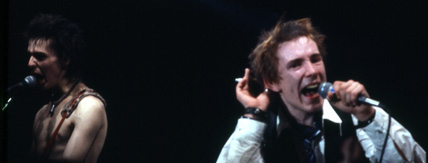
The Great Southeast Music Hall gained international notoriety when Alex Cooley booked the first U.S. appearance of the Sex Pistols, Jan. 5, 1978. The Hall was packed minutes after the doors open at 7:00 p.m. Among the attendees that night are 5 television crews, approximately 50 members of the press, several police officers and vice squads from both Atlanta and Memphis(where they would perform the next night)... after a local band called Cruisomatic opens the Pistols take the stage at about 10:15 p.m.; Rotten asks, "Where's My Beer?"... "You can all stop staring at us now," Rotten says after opening with "God Save the Queen," "We're ugly and we know it... See what kind of fine upstanding youth England is chucking out these days?"...About 60% of the audience is standing and doing an Americanized version of the Pogo throughout, 20% of the audience is nasty, yelling yelling and throwing things at the band, and 20% of the crowd clearly does not know what on earth is going on... And that's Punk Rock!! Nine days later, Rotten would play his last show with the Pistols.
Ten months later, Sid Vicious would be arrested for the murder of his girlfriend, Nancy Spungen. After Sid spent some time in Riker's Island Prison, McLaren convinced Virgin Records to put up the $50,000 to bail Sid out. At a party celebrating his release on Feb. 2, 1979, Sid Vicious died from an overdose of heroin.
Sunday, August 15, 2010
Atlanta's OG
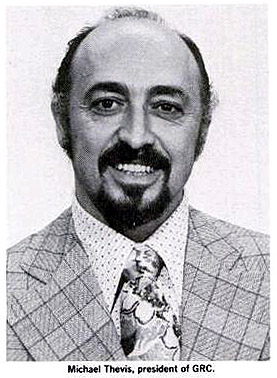
Michael Thevis was born in 1932 in Raleigh, North Carolina, where he was raised by his Greek Orthodox grandparents. They had emigrated from Greece and brought up young Michael strictly and in the ways of the church, keeping him in from play to teach him the value of work. In 1949 Michael left home and moved to Atlanta, where he enrolled at Georgia Tech and began to take engineering courses. He couldn't afford to stay in school, though, and dropped out in 1950 to run a newsstand. By 1960 little had changed. He was married with three children, but his newsstand job was barely covering the cost of living. The Thevis family was forced out of their apartment one month when he could no longer afford to pay the rent, which had recently been raised to $57. Thevis' entry into criminal enterprises began one day while going over the books for his newsstand. He discovered that, while Playboy only accounted for 10% of his sales, it was almost solely responsible for his turning a profit. He went underground, and while overtly selling only tame nudie publications, he worked with gangster and pornographer Kenneth "Kenny the Jap" Hanna to make contacts with customers whose interests were far more suspect. Soon Thevis was using the newsstand to deal in black market pornography including hardcore bondage, rape, bestiality and, eventually, child porn. Business boomed. In the last half of 1967s Hanna introduced Thevis to a fellow gangster, Roger Dean Underhill, a low-ranking associate of the Gambino organized-crime family. Together Underhill and Thevis would move the small underground porn stand to the next level. Underhill recalled machines he'd seen at fairs and in supermarkets that played cartoons to keep children occupied. Using this concept, Underhill and Thevis developed some of the first sexually oriented peep booths in America. They set up manufacturing companies and began to distribute the peep booths to locations all over America, from New York to Pasadena, California, to locations ranging from airport bars to the sex shops on 42nd Street in New York City's Times Square. By the end of the 1970s the phrases "loop" and "peep booth" would be synonymous with sleazy porn. One of Thevis' first tastes of competition came from Nat Bailen, owner and founder of Urban Industries, which manufactured peep booths. In the early 1960s Bailen had invented peep booths to show children's cartoons on. He publicly spoke out against Thevis for turning his creation into a smut machine. In April of 1970 Urban Industries was burnt to the ground: fire investigators ruled it an arson. Another major crime linking Thevis to the world of organized crime came in November of 1970, when Kenny Hanna turned up murdered. Investigating the case, the FBI turned up Thevis' name. What began as a routine check into what the FBI believed was one more murdered gangster ended with the realization that they had stumbled onto the man who'd become responsible for distributing 40% of the United States' pornography, legal and illegal. In addition to his black-market and peep-show enterprises, he also owned nearly 500 adult bookstores and X-rated movie theaters across the country. The government estimated his annual income at $100 million. Word reached Thevis that he was under investigation. Aware that gangsters Al Capone and Dutch Schultz were brought down by federal investigations into their finances, Thevis began to branch out into legitimate enterprises, not only to account for his illegal income, but to launder some of it and make even more cash in the process. His peep booths were manufactured by one of his legitimate fronts, Cinematics. He owned General Recording Corp., a music distributor, and began to produce movies. He fronted the cash for Zhui ming qiang (1971), and anonymously put up money for one of Oliver Stone's earliest films, Seizure (1974). In 1973, Roger Dean Underhill was present when James Mayes, an employee of Cinematics, came to Thevis asking for a raise. Thevis was incensed, and shot Mayes to death. Shortly thereafter, Underhill was arrested during a routine traffic stop when the alert officer found a small cache of stolen guns in Underhill's car. Underhill was booked on charges of possession of stolen weapons and transporting stolen property across state lines; conviction meant a long stretch in federal prison. Sensing a potential breakthrough in their investigation of Thevis, the FBI got involved, offering Underhill leniency in exchange for his help in bringing down Thevis. Underhill was getting no assistance from the mob; he was too low-ranking to be seen as anything more than a liability, so he agreed to turn states' evidence. Over the next three years he helped the FBI in building charges against Thevis, and revealed in a sworn affidavit that Thevis had given him the order to set the fire that burned down Urban Industries. He further revealed that he was acting as backup when Thevis murdered Kenny Hanna, and that he was present during the murder of James Mayes. The FBI also learned about crimes they had never linked Thevis to, including the bombing of one of Thevis' competitors in Fayeteville, Kentucky, and his extortion of a small-time pornographer in Houston. Meanwhile, Thevis continued to get richer, funding another movie, Poor Pretty Eddie (1975), and extending the reaches of his porn empire into Florida. The beginning of the end for Thevis came in 1976, when he was convicted of conspiracy to commit arson, and distribution of obscene materials; Underhill personally testified against his former partner. Thevis was sentenced to eight years and six months in prison and ordered to pay $650,000 to Nat Bailen, the employees of Urban Industries, and Urban Industries' insurance companies. In prison Thevis received word that his wife had divorced him and that the IRS had teamed up with the FBI to investigate him for financial fraud. The icing on the cake came when Thevis was indicted in Florida on various charges under the RICO statutes, thanks largely in part to Roger Dean Underhill. Thevis escaped from prison in 1978 and was immediately placed on the FBI's top ten most wanted list. Word got to the FBI that Thevis had contacted old associates in the mob and arranged for a contract to be put on Underhill's life as revenge his betrayal. Underhill became one of the most sought-after gangsters in America, as word spread to every wiseguy and gunman that an "open contract" had been placed on him--in other words, no specific hitman was tasked with the job; whoever could prove they killed Underhill would receive a substantial reward. No one ever got to collect, though, because Thevis personally tracked down Underhill himself. Underhill was entertaining a friend, street tough Isaac Galanti, in October of 1978 when Thevis showed up at the front door and killed both men with a shotgun. Thevis was apprehended shortly after the murders and taken for holding to a maximum security facility in Connecticut. Awaiting his RICO trial in Florida, he tried to establish a "prison rep" by bragging to other prisoners about his various murders, including Underhill and Galanti. His cellmate contacted authorities. In 1980, Michael Thevis, the "Scarface of Porn," who had once made $100 million a year and owned nearly half of the hardcore porn industry, was convicted of the murders of Isaac Galanti and Roger Dean Underhill. He was sentenced to 28 years to life, and became eligible for parole in 1998.
Source: IMDb Mini Biography By: Jojo Mac
Friday, August 13, 2010
August 13, 1910
Gov. Joseph M. Brown signed Georgia's first law regulating the use of automobiles. Among the provisions, every vehicle had to be registered with the Secretary of State, had to have a license plate bearing the registration number, and had to have at least one headlight capable of projecting a beam 100 feet at least one red taillight illuminating the license plate. The law mandated no specific highway speed limit except to provide that driving speed must be "reasonable and proper." However, vehicles had to slow to 6 miles per hour when approaching a bridge, sharp curve, or intersection The minimum driving age was set at 16, unless a minor had a year's experience driving and was accompanied by the owner of the vehicle. And, the law made it illegal to drive while intoxicated.
Tuesday, August 10, 2010
Devil Went Down To Georgia
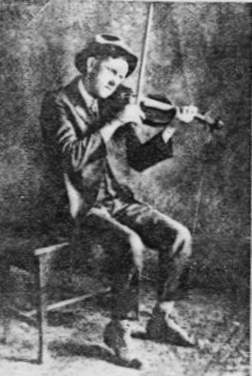
Born in Fannin County in March of 1868, Pioneer hillbilly fiddler John Carson made his way out of the North Georgia Mountains to Atlanta. Where when he wasn't working in the cotton mills, painting houses, or making moonshine, he made a living playin' and passin' the hat. Startin' 'bout 1913, the annual fiddlers' conventions at the City Auditorium in downtown Atlanta drew large crowds of listeners and John became a principal figure at annual fiddlers' convention, seven times being named Fiddler Champion of Georgia. In April 1922 WSB, the south's first Radio station went on air. Now short time later, September I believe, Fiddlin' John Carson walk in to its studios. He announced to engineer Lambdin Kay, "that he would like to have a try at the newfangled contraption." Kay could see no reason not to, so he obliged him. Fiddlin' John performed "Little Old Log Cabin in the Lane." This was the first of what we know today as "country music" to be broadcast by radio. How much did he make for this historic broadcast you ask? A snort from Lambdin Kay's bottle of whiskey! The folks at WSB liked him so much, that they gave him the only regularly scheduled 10pm-radio program in the country (making him the Johnny Carson of his time). WSB's signal carried into 38 states, Canada and Cuba. His wide spread popularity inspired Atlanta furniture dealer, Polk Brockman, to persuade OKeh records president Ralph Peer to bring his recording equipment to Atlanta to record Fiddlin' John.
So it came to be that on June 14, 1923, Peer brought his recording equipment to a vacant building on Nassau Street in Atlanta and John cut two sides, "Little Old Log Cabin" and "The Old Hen Cackled and the Rooster's going to Crow." Making it the first country music recording and arguably the beginning of the country music industry. Peer deemed the cuts to be "pluperful awful" but agreed to press five hundred on a blank label for Brockman's personal use. At the next Fiddler's convention, Fiddlin' John hawked them from the stage and Brockman promptly sold every disc. Seeing that Americans disagreed with him, Peer immediately rushed into a major pressing on the OKeh label making it the first hit in the history country music. He invited Carson to New York to record twelve more sides. Carson remarking on his newfound success said; "I'll have to quit making moonshine and start making records."
I would like to sidetrack for a moment here and say a few words about music man Ralph Peer. Growing up with the record industry, 35-year-old Kansas City native Peer, Pioneered the new technique of on-location recording. This is the technique; He would simple roll into a Southern town and contact the local Victor dealers, music storeowners, and radio station operators to locate local talent. Then he would record them on the spot for $50 a selection plus royalties of about 2 1/2 cents per side. Now if you are a fan of the Andy Griffith Show, like me, you will remember when the National Records man came rolling into town. To stay with the Andy Griffith Show a little longer. Remember those crazy songs the Darling clan played, like; "Tear up your old clothes for rags" or "Slimy River Bottom" and you can't forget "Keep your money in your shoe and it won't get wet." Not that one Paw, it makes me cry! Fiddlin' John had some just as wild, like; "It's A Shame to Whip Your Wife On Sunday", "Who Bit The Wart Off Grandma's Nose", "Whatcha Gonna Do When Your Licker Gives Out?" "Ain't No Bugs On Me", and my favorite "You Can't Get Milk From A Cow Named Ben." Back to Fiddlin' John, he hit the road and toured as a member of The Virginia Reelers. Later his daughter, Rosa Lee, toured with him. Over time a comedy routine emerged out of the banter between Carson and Moonshine Kate (Rosa Lee's stage name) in which he was the "moonshine reprobate and she was the sassy, snuff-dipping mountain gal" who usually ended up out-wisecracking her father. Sort of a hillbilly Sonny & Cher. They traveled as far as Mexico and Canada in their Model T Ford. Fiddlin' John Carson and his daughter,"Moonshine Kate", were the first stars, despite this fact little of the fame and none of the fortunes produced in the country music industry were ever theirs.
Music legend Charlie Daniel took his inspiration for his hit; "Devil Went Down To Georgia" from Poet Stephen Vincent Benet 1920's poem: The Mountain Whippoorwill (Or, How Hill-Billy Jim Won the Great Fiddlers' Prize). It Described the Atlanta Fiddlers' Convention, the year young Lowe Stokes defeated Fiddlin' John Carson for the Fiddling Championship. In Carson's own youth, he beat Tenn. Gov. Bob Taylor in a contest. Carson, in a sense, plays both parts in this tale. He also sawed his on version.
But his star faded and by the '40s he was working as lift operator in Atlanta, where he died Dec. 11,1949.
Subscribe to:
Posts (Atom)